Here it is late February in Whatcom County, Washington. How is your winter going? Average temperature 45°F, humidity running about 77% or higher, we have our typical overhead gray sky…maybe a tease of a few sunny days or sun breaking through the clouds. Overall pretty drab right?
Our weather not really getting to that 50°F degree sweet spot to open your hives…. days go by….then all of a sudden the sun breaks out, it’s 55°F – 57°F …but alas you are at work or other worldly obligation(s). Days go by and finally, you have the a day off, and the sun comes out, you look at the weather for the day and high noon it’s going to be 57°F !
STARVATION: Honey bee starvation is a state where honeybee experiences shortage of food, honey…due to various circumstances and may be caused by unfavorable weather, disease, long distance transportation or depleting food reserve. https://en.wikipedia.org/wiki/Honey_bee_starvation
Since you know the weather is giving you the opportunity to take a peak into your hive…..You run around, finding your bee jacket and gear; smoker with fuel, lighter, hive tools, and supplement sugar feed for the bees. Knowing that even in the somewhat mild winter we are experiencing in Whatcom County; your bees probably have not been out of the hive too much, to find a good nectar in season food source. You know there are a variety of ways to feed your hive; candy boards, fondant, sugar bricks, or granulated sugar placed on top of frames or liquid 2:1 mixture.
SIMPLY: They [the honeybees] run out of food and dive head down “with butts in the air”. During winter or early spring, the honeybee dives deep into the cells searching for food because they are unable to relocate to food stores. This sign is commonly known as isolation starvation.
Now you get to your hive and open it up and upon inspection you SEE:
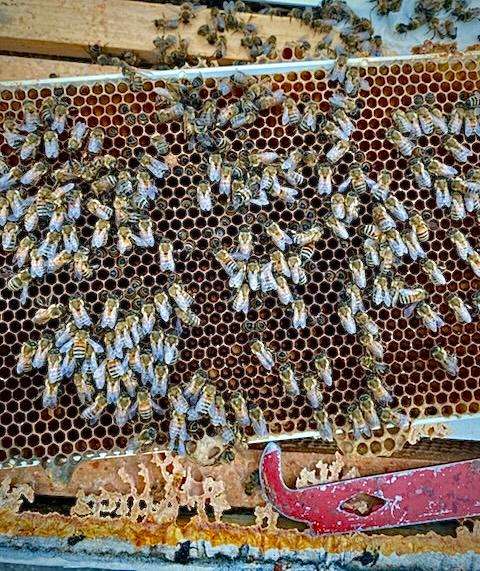
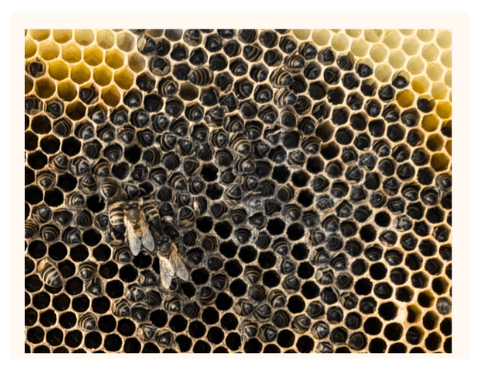
searching for food” Photo credit: Animal & Plant Health Agency
Nutrition shortages and stressors (weather, disease, lack of forage) can lead to starvation in honey bees and beekeepers must prepare for such possible occurrences. Other stressors that make things generally worse for the honeybee are: Varroa mite infestations and their viruses which weaken the honeybee colony. Weakened by lack of sufficient nutrition combined with after affects of Varroa mite infestations, the poor honeybee, simply cannot maintain their thermal cluster and move to the areas in the hive where they have stored honey, that is if they have any honey left….
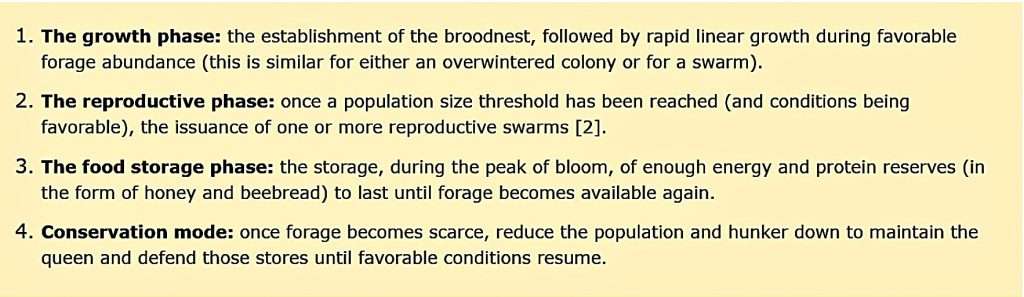
Randy Oliver, Scientific Beekeeping has an in-depth article “Understanding Colony Buildup and Decline: Part 9a – The Regulation of Bee Longevity“ (January 28, 2016), which provides valuable information on “The Business Model of the European Honey Bee“. I highly recommend reading Randy Oliver’s article. Being a beekeeper, one should understand the life cycle of not only the honeybee itself but the phases of the colony life cycle. Per Randy Oliver, he has divided the colony life cycle into four phases:
Another great resource is from the Animal & Plant Health Agency National Bee Unit (United Kingdom -UK). This UK agency has a great article on Starvation (December 2025). With weather being somewhat similar between the UK and Pacific Northwest, I feel their article can provide good basic information that is applicable to this area. In general, what the National Bee Unit says regarding honeybee starvation, during the this time of year:
- Open your hive, check on a bright, calm winter or early spring day,
- Check to prevent starvation by “Hefting” (weighing) your hive, tilting your hive and lifting each side to feel the weight,
- Check supply of stored honey,
- In warmer weather sugar syrup can be fed to colonies low on stores however if it is colder, the bees won’t be able to access it, so a block of fondant should be fed to the colony,
- Recognize the signs of starvation; cells around brood nest are dry, capping’s have been nibbled, pupae can be removed and or thrown out of the entrance, honeybees are lethargic and then the sign of honeybee with head-down (butts in air) searching for food.
So what urgent actions can you do if you find your honeybees are on the brink of starvation? Feed your honeybees without delay, be prepared before you even open your hive up.
- Feed sugar syrup when temperature are above 50°F, as any freezing weather can cause excessive moisture inside the hive leading to condensation dripping down on the honeybees. Ration 2:1 Winter Syrup. Heat water until it boils, remove from heat, and stir in sugar until fully dissolved. Ensure it is cool to room temperature before feeding (pouring it into a feeder which is already placed into the hive).
- Feed dry solid food. Dry Sugar (Mountain Camp Method): Place newspaper on top of frames and pour dry granulated sugar on top. Candy Boards: Provide a long-lasting, moisture-absorbing food source. Fondant: Placed directly on top of the frames above the cluster.
- NOTE: Sugar Type: Use only refined white cane or beet sugar. Never use raw, brown, or molasses sugar, as this can cause dysentery.
At the end of the day, or at least before those early sunsets happen upon us, you feel somewhat accomplished in that you were able to identify nutritional needs of your bees, assess your hive for Varroa issues and overall you took care of your honeybees. You gather your tools up, turn and walk away, return to your car, tossing your bee suit in the back, climbing back into your car. All of a sudden you feel intensely hungry and thirsty…minutes later you are driving through the DQ drive up window, you pay for your hamburger deluxe and cold chocolate shake, your mind wanders…. thinking…. could I have done anything different to avoid the starvation of your honeybees….